
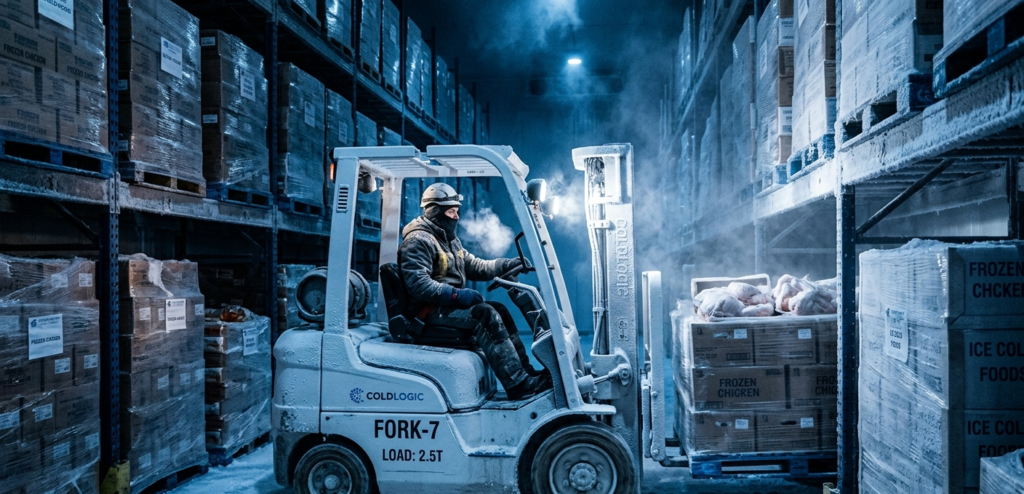
- Transporting food and pharmaceuticals requires cold storage environments, often reaching temperatures as low as -30°C. For a forklift, these conditions are brutal. Condensation, frozen lubricants, and rapid battery drainage are constant threats. Managing a fleet in a cold room requires specialized equipment and a meticulous approach to maintenance that differs significantly from standard warehouse operations.
- The biggest challenge in cold storage is the “Transition Zone.” When a forklift moves from a freezing room to a warm loading dock, condensation forms instantly. If the forklift goes back into the freezer without drying, that moisture turns into ice, potentially cracking electronic components or seizing hydraulic valves. “Cold-Store Conditioned” forklifts feature heated cabins and sealed electronics to prevent this moisture damage and keep the operator warm and focused.
“In the cold chain, reliability isn’t just a goal—it’s the only thing keeping your inventory from melting away.”
Operating Forklifts in Extreme Cold: A Guide to Cold Chain Logistics
- Battery performance also takes a massive hit in the cold. Lead-acid batteries can lose up to 50% of their capacity in freezing temperatures. This is where Lithium-Ion technology shines. Lithium-Ion batteries can be equipped with internal heaters that maintain a stable operating temperature, ensuring they provide full power even in sub-zero conditions. This eliminates the need for frequent battery swaps and keeps the cold chain moving without interruption.
- Safety is amplified in the cold. Icy floors lead to traction issues, and thick thermal gear can limit an operator’s range of motion. Specialized tires with high-grip compounds and extra-bright LED lighting are essential for visibility in foggy freezer environments. By choosing equipment specifically engineered for the cold, logistics providers can ensure that their sensitive cargo—and their people—are protected from the harsh realities of the environment.