
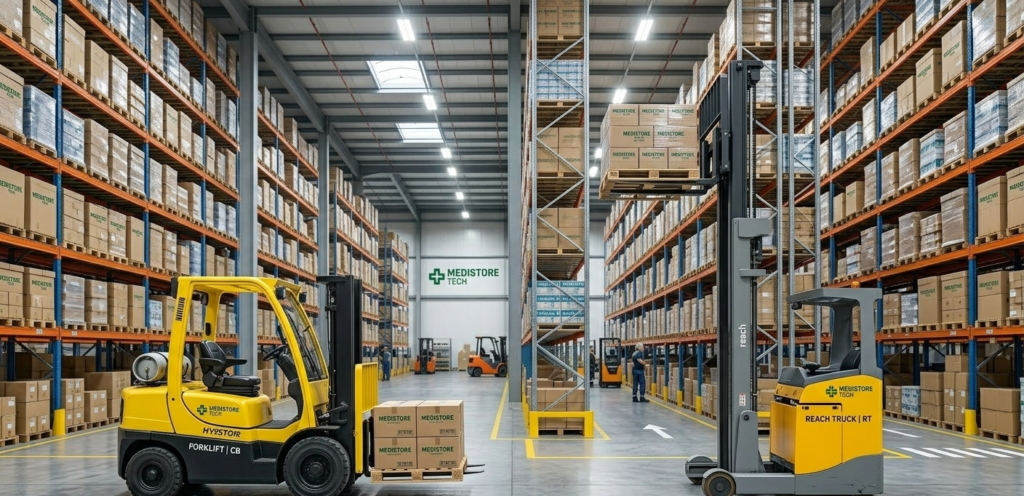
- The efficiency of your warehouse depends heavily on matching your equipment to your storage layout. While both reach trucks and counterbalance forklifts are staples of the industry, they serve very different purposes. Making the wrong choice can lead to wasted aisle space or slowed-down picking cycles. Understanding the structural differences and operational strengths of each is essential for any growing logistics business.
- Counterbalance forklifts are the versatile “workhorses” of the yard and dock. They are designed for high-speed transport and heavy lifting, using a weight at the rear to balance the load at the front. Because they have larger wheels and a sturdier build, they are often the preferred choice for unloading trucks and working on uneven outdoor surfaces. However, their large turning radius makes them difficult to use in high-density, narrow-aisle storage systems.
“The right forklift doesn’t just move a pallet; it unlocks the hidden potential of your warehouse architecture.”
- Reach trucks, on the other hand, are the kings of indoor height optimization. They are designed specifically for narrow aisles, with outriggers that distribute the weight of the load. The “reach” mechanism allows the forks to extend into the racking, enabling deep storage configurations. Because they can lift much higher than a standard counterbalance truck, they allow warehouses to grow “up” instead of “out,” maximizing every square inch of expensive floor space.
- When deciding between the two, consider your aisle width and maximum rack height first. If your operation involves moving goods from a truck directly to a high rack in a tight space, a reach truck is indispensable. If you primarily move heavy pallets over long distances or across varied terrain, the counterbalance forklift is your best bet. Often, a balanced fleet containing both types of equipment is the ultimate solution for a high-velocity distribution center.